Sowing
Ages 6–8
How your child grows
Dares to touch, dares to try, is not afraid of mistakes.
Tools
- • NEO One computer with GCompris in Vietnamese
- • Camera and voice games on NEO
- • Lesson 1 on the simulator, no robot needed
The Làng Maker handbook
At Làng Maker (the Maker Village), children play with robots to learn how to think. A path for tinkering with robots from age 6: play to get curious, build something that actually works, then tell someone else how you did it.
We learn the way Seymour Papert (MIT) described: children learn deepest when they make something they care about. See why →
Five-year goal: one million Vietnamese children with access to STEM & robotics
Pick the age band to see where to start, and how your child grows at that stage.
Sowing
How your child grows
Dares to touch, dares to try, is not afraid of mistakes.
Tools
Branching
How your child grows
Fixes their own bugs and keeps going until the robot runs.
Tools
Bearing fruit
How your child grows
Builds real projects, works in a team, enters a first competition.
Tools
Returning to the roots
How your child grows
Leads, teaches the younger ones, carries the flag abroad.
Tools
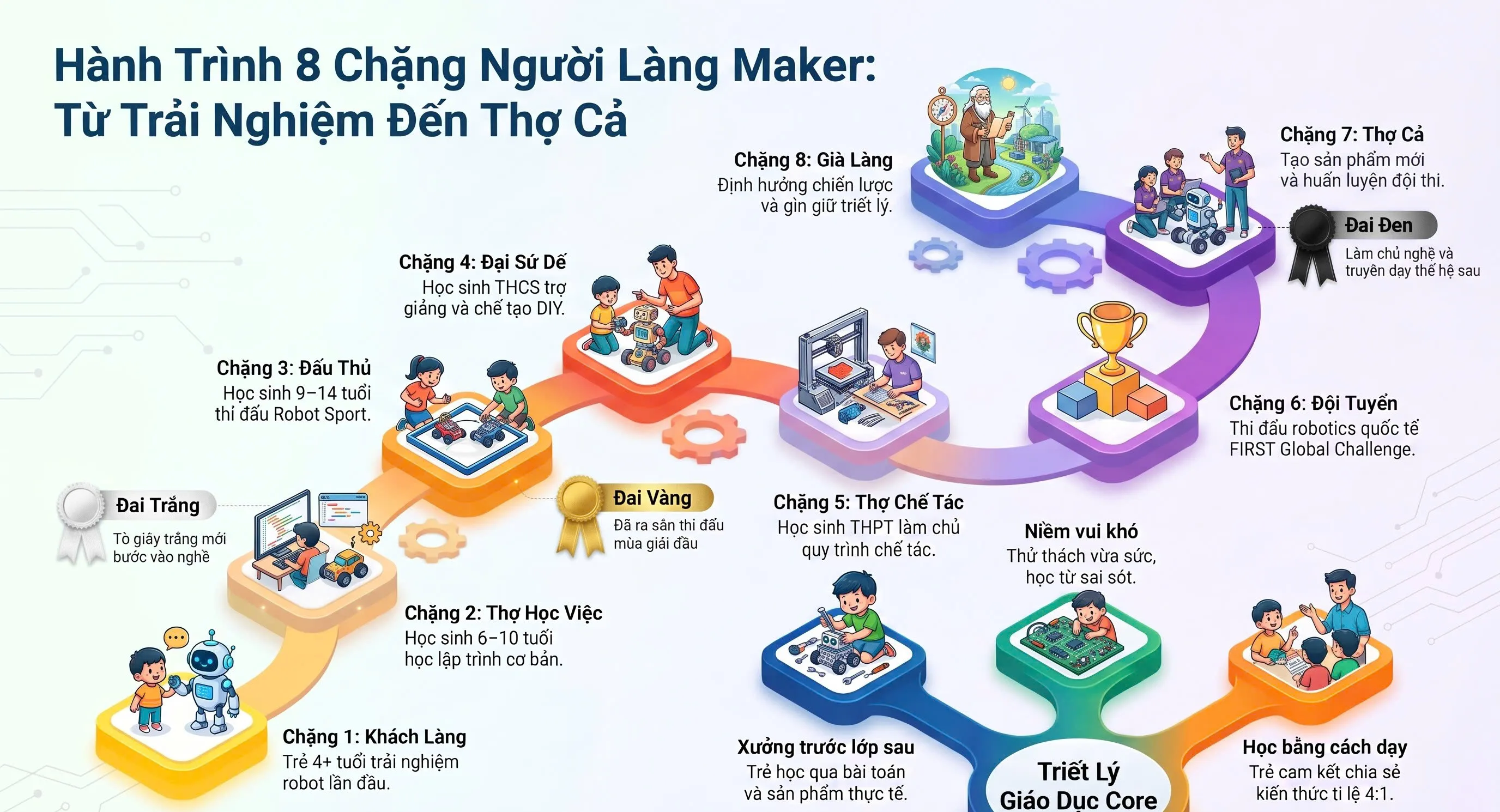
From Khách Làng (village guest) to Già Làng (elder), in four seasons of the bamboo. Nobody has to climb all the way; each stage is a real place to stand.
Electronics, robotics and AI are not three separate subjects. They meet in the robot and grow with the child.
Press a button and see a light, then plug in motors, then design your own sensor circuit.
Drive a robot through a maze, then program in blocks, then build a self-driving car.
Say “forward” and the robot moves, then teach the machine gestures, then delegate to an agent and check when it is wrong.
The skills that stay: systems thinking, breaking big work into small steps, debugging, teamwork, explaining to others, and using AI as a tool: knowing how to delegate to the machine, how to check when it is wrong, and never letting it do the work for you.
FanRoc is the entry competition for school students in Vietnam: launched in November, finals in March. At the village, students prepare with ThingBot, ThingBlock, a PS2 controller and the simulated field.
A united front for STEM education — everyone brings what they have, in the spirit of Hồ Chí Minh’s call: “those who have rifles, use rifles; those who have swords, use swords”
Maker community & open source
STEM education & software
ThingBot educational robot
Maker Hub network
International robotics challenge
Children can start from age 4 — beginning with the Play beat, completely free.